An original EVA educational reading note, not a full translation. Illustrations by EVA. Follow the primary sources for the full paper and author credits.
The contribution
Vaswani and seven co-authors introduced the Transformer: an encoder–decoder architecture using attention without recurrent or convolutional layers. Attention combines vector representations using learned relevance weights.

Where parallelism applies
Many training computations can run in parallel, while autoregressive decoding still produces outputs sequentially. A causal mask blocks future positions. The original experiments primarily concern machine translation; they do not establish universal intelligence or answer reliability.

An EVA reading protocol
Our proposed lab starts with a four-column evidence log: claim, source location, verification and limitation. Choose one falsifiable question and a small experiment. Write down what would contradict your hypothesis before running it. Keep observations separate from interpretations and assumptions.
Lab: testing a causal mask
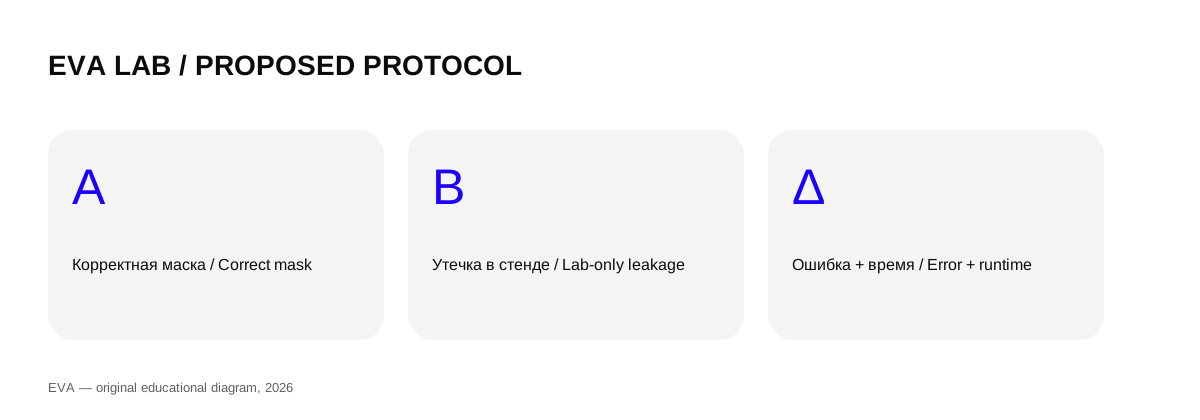
Using synthetic sequences, compare correct masking with deliberately leaked future tokens in an isolated lab. Our proposed hypothesis is that leakage explains deceptively strong scores. Keep data splits, compute budgets and random seeds comparable. Measure errors and runtime over repeated runs. This is an EVA exercise, not an experiment reported by the paper.
Bring to the discussion
Bring your question, evidence log, code, configuration, repeated results and error analysis. Ask whether an independent sample is needed, how sequence length changes the outcome, and which conclusions remain unsupported. Do not invent measurements.
Primary sources
- Vaswani et al. — Attention Is All You Need, arXiv:1706.03762 (2017)
- Google Research — publication record
- arXiv distribution license
The paper is named at 02:17:34 in the source interview transcript. Citation-ranking claims have not been verified and are not repeated here.